
THE SYSTEMIC LEADERSHIP DEVELOPMENT FRAMEWORK™
Developing the Capacity to Lead, Adapt and Create Meaningful Impact
The Systemic Leadership Development Framework™ is an integrated approach to human and leadership development built around a central question:
What capacity needs to develop for something different to become possible?
Rather than beginning with a predetermined programme or set of leadership competencies, the framework begins with the reality people face and considers the individual, relational, organisational and systemic factors shaping that reality.
Its purpose is to develop increasingly resourceful people who are better able to understand themselves, think effectively, engage and lead others, navigate complexity and translate greater capacity into meaningful action.
Development is therefore not simply about knowing more. It is about becoming increasingly capable of engaging with reality and acting within it.
THE ARCHITECTURE
A Living System of Development
The framework uses the metaphor of a living tree because development does not happen in isolation.
What becomes visible in behaviour, leadership and performance is influenced by deeper foundations — identity, purpose, values, experience, relationships, culture and the systems within which people live and work.
The framework therefore traces development from context and foundations, through the capacities that people develop, to the ways those capacities are expressed through leadership and ultimately translated into impact.
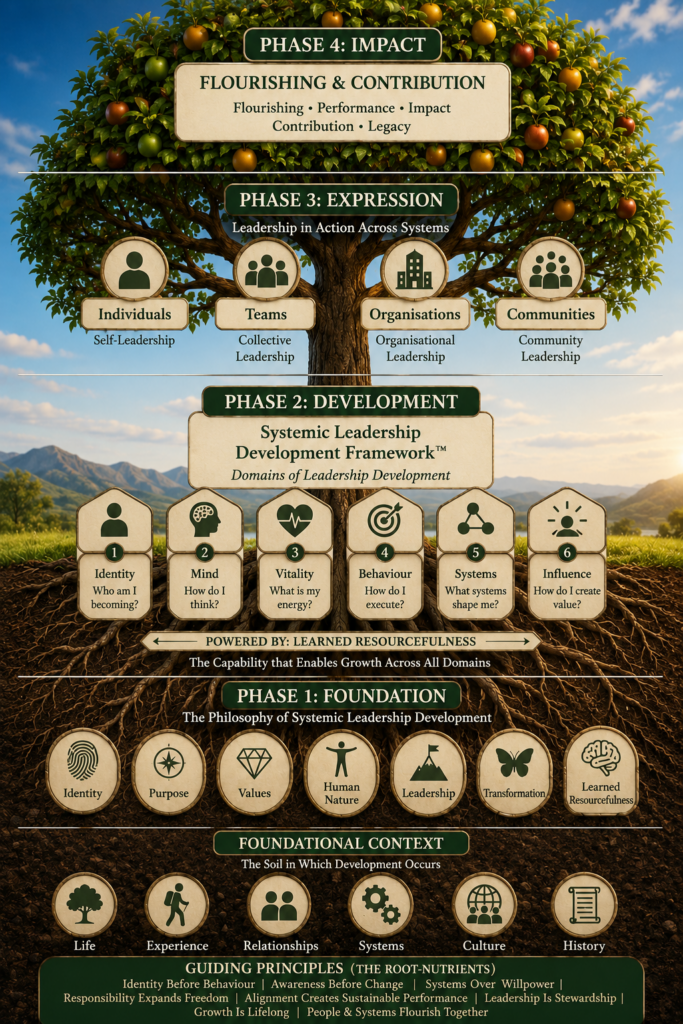
READING THE FRAMEWORK
The framework can be read from the ground upward, but it should not be understood as a rigid sequence.
Context shapes development.
Philosophy provides its foundations.
Learned Resourcefulness powers the development of capacity.
Six developmental domains identify what can be developed.
Leadership is expressed through individuals, teams, organisations and communities.
Impact is reflected in flourishing, performance, impact, contribution and legacy.
Each layer influences the others. Change in one part of the system can create possibilities — or constraints — elsewhere.
FOUNDATIONAL CONTEXT
Development Always Happens Somewhere
Human development never begins from a blank slate.
Every person enters development shaped by a particular life, accumulated experiences, relationships, social and organisational systems, culture and history. These form the context within which people make sense of themselves, others and the world around them.
The framework refers to this as the soil in which development occurs.
Just as the quality and conditions of soil influence what a tree can become, context can enable, constrain and shape human development. It influences what people learn, what they come to believe, how they relate to others, the opportunities available to them and the patterns they develop over time.
Understanding context does not mean that people are determined by their circumstances. It means recognising that meaningful development requires us to understand the realities within which people are attempting to change, lead and perform.
LIFE
The wider realities and circumstances within which a person lives and develops.
EXPERIENCE
The events, challenges, successes and failures through which understanding and capability are formed.
RELATIONSHIPS
The people and relational patterns that influence identity, behaviour, belonging and development.
SYSTEMS
The structures, institutions, processes and interdependencies that shape possibilities and constraints.
CULTURE
The shared assumptions, norms, values and expectations that influence how people understand and respond to their environment.
HISTORY
The accumulated personal, organisational and social past that continues to influence present realities.
Context does not determine what people can become, but it forms part of the reality within which development must occur.
PHASE 1 — FOUNDATION
The Philosophy Beneath the Practice
Every approach to human development rests upon assumptions about people, change, leadership and what development is ultimately intended to accomplish.
The Systemic Leadership Development Framework™ makes those assumptions explicit.
Its foundation consists of seven interconnected ideas that shape how development is understood and approached:
Identity • Purpose • Values • Human Nature • Leadership • Transformation • Learned Resourcefulness
These are not simply topics to be taught. They provide the philosophical foundation from which the rest of the framework is constructed.
01 — IDENTITY
Who we understand ourselves to be shapes how we engage with reality.
Development involves not only changing what people do, but examining the identity, beliefs and assumptions from which behaviour emerges.
03 — VALUES
Values provide criteria for choice.
They help people determine what matters, what should guide behaviour and whether actions remain aligned with what they profess to value.
05 — LEADERSHIP
Leadership is the exercise of capacity in relation to others and the realities we share.
It extends beyond position or authority and involves influence, responsibility, judgment, contribution and stewardship.
02 — PURPOSE
Development requires direction.
Purpose gives meaning to growth by connecting increased capacity with what a person, team or organisation is seeking to become, accomplish or contribute.
04 — HUMAN NATURE
How we understand people influences how we attempt to develop them.
The framework recognises people as capable of learning, choice, responsibility, relationship, adaptation and continued development.
06 — TRANSFORMATION
Sustainable change involves more than temporary behavioural adjustment.
Development can require changes in how people understand themselves, interpret reality, relate to others and act within the systems around them.
07 — LEARNED RESOURCEFULNESS
Development should increase people’s capacity to engage constructively with reality.
Learned Resourcefulness provides the developmental engine that connects understanding with greater self-regulation, thinking, learning, adaptation and intentional action.
Learned Resourcefulness is both a foundational principle and a developmental capability: it informs how development is understood while also describing the growing capacity through which people learn to regulate, think, adapt and act more effectively.
PHASE 2 — DEVELOPMENT
Developing the Capacity to Engage With Reality
The foundations of the framework shape how development is understood. The next question is what, specifically, needs to develop.
The Systemic Leadership Development Framework™ considers development across six interconnected domains. These domains recognise that leadership capacity is not located in a single skill, behaviour or competency.
People lead through who they are, how they think, the energy they bring, how they act, how they understand the systems around them and the influence they are able to exercise within those systems.
Development therefore involves increasing capacity across six domains:
01 — IDENTITY
Who am I becoming?
Identity concerns how people understand themselves, the roles they occupy and the person or leader they are becoming.
Development in this domain strengthens self-awareness, personal agency, alignment and the capacity to act from an increasingly conscious understanding of self.
02 — MIND
How do I think?
The quality of action is influenced by the quality of thinking that precedes it.
This domain develops the capacity to observe, question assumptions, make sense of complexity, learn from experience, exercise judgement and make increasingly considered decisions.
03 — VITALITY
What is my energy?
Capacity requires more than knowledge and intention. People must also have the physical, emotional and psychological resources to engage effectively with the demands they face.
This domain considers energy, resilience, emotional regulation, wellbeing and the ability to sustain meaningful effort over time.
04 — BEHAVIOUR
How do I execute?
Development must ultimately become visible in action.
This domain focuses on translating awareness, intention and learning into behaviour — including habits, communication, decision-making, discipline, adaptability and consistent execution.
05 — SYSTEMS
What systems shape me?
No person, team or organisation operates independently of the systems around them.
This domain develops the capacity to recognise patterns, relationships, structures, incentives, constraints and interdependencies — and to understand how these influence behaviour and outcomes.
06 — INFLUENCE
How do I create value?
Leadership becomes consequential through its effect on others and the systems within which people operate.
This domain develops the capacity to engage, communicate, build relationships, mobilise others, exercise responsible influence and contribute value beyond oneself.
These domains are interconnected rather than independent. Development in one can strengthen — or expose constraints within — another.
A challenge that initially appears behavioural, for example, may have its origins in identity, thinking, vitality or the surrounding system.
This is why the framework begins with the reality being experienced rather than assuming in advance what needs to be developed.
LEARNED RESOURCEFULNESS
The Developmental Engine
Learned Resourcefulness runs through all six developmental domains.
It is the growing capacity to work constructively with oneself and one’s circumstances — to regulate responses, think and learn effectively, adapt to changing realities and translate understanding into intentional action.
The objective is not simply to increase knowledge, nor is it to create dependence upon external expertise.
It is to increase their capacity to respond resourcefully to realities they will continue to encounter long after a particular coaching, leadership or development engagement has ended.
PHASE 3 — EXPRESSION
Leadership Becomes Visible in Relationship and Systems
Development does not end with the individual.
Capacity becomes meaningful when it is expressed through the relationships, responsibilities and systems in which people participate.
The framework therefore considers leadership across four interconnected levels of expression.
INDIVIDUALS
Self-Leadership
The capacity to understand oneself, exercise agency, make considered choices and take responsibility for one’s development, behaviour and contribution.
TEAMS
Collective Leadership
The capacity of people to work together around shared purpose, navigate relationships and differences, learn collectively and create conditions for sustainable performance.
ORGANISATIONS
Organisational Leadership
The capacity to shape cultures, structures, decisions and systems that enable people and the organisation to adapt, perform and fulfil their purpose.
COMMUNITIES
Community Leadership
The capacity to contribute beyond formal organisational boundaries by understanding interconnected interests, engaging stakeholders and helping create conditions in which wider communities and systems can flourish.
Leadership is therefore understood not merely as a position, but as the expression of developed capacity in relation to people, responsibilities and systems.
PHASE 4 — IMPACT
From Development to Meaningful Contribution
Development has a purpose beyond development itself.
Greater awareness, resourcefulness and leadership capacity should ultimately change what becomes possible for individuals, teams, organisations and the systems of which they form part.
The framework considers this through five expressions of impact:
FLOURISHING
enabling people and systems to develop and function in increasingly healthy and sustainable ways.
PERFORMANCE
strengthening the capacity to translate purpose, resources and effort into meaningful results.
IMPACT
creating changes that matter within the realities being addressed.
CONTRIBUTION
applying developed capacity in ways that create value beyond oneself.
LEGACY
leaving behind strengthened people, relationships, institutions and systems capable of continuing beyond one’s direct involvement.
Impact therefore cannot be reduced to performance alone.
The deeper objective is to develop people and systems capable of performing, adapting, contributing and flourishing together.
THE FRAMEWORK IN PRACTICE
The Framework Is a Map, Not a Prescription
The Systemic Leadership Development Framework™ is not intended to move every person, team or organisation through the same sequence of predetermined interventions.
It provides a way of understanding the reality being experienced and identifying where greater capacity may need to develop.
A leadership challenge may appear to concern behaviour but reveal assumptions about identity. A performance problem may be influenced by relationships or systems. A team challenge may require individual development. An organisational problem may reflect culture, structures or patterns that cannot be addressed through individual effort alone.
For this reason, the work begins with inquiry:
What is happening?
What is shaping this reality?
What is trying to become possible?
What capacity needs to develop for that to occur?
The answers help determine where within the framework the work should begin.
Development may then move between domains and levels as understanding deepens and circumstances change.
The framework provides structure without reducing the complexity of people and organisations to a formula.
FROM FRAMEWORK TO PRACTICE
What Needs to Become Possible?
You do not need to understand the framework in detail or know where within it your challenge belongs before we speak.
The starting point is the reality you are facing.
Whether you are navigating a personal or leadership transition, strengthening a team, addressing an organisational challenge or seeking to create something different, we can begin by exploring what is happening, what may be shaping it and what capacity needs to develop.
Meaningful development begins by understanding the reality — and discovering what needs to become possible.